
Changelog

Follow new updates and improvements to Vero.

Ad-hoc segments, Timezone sends, Push broadcasts and more
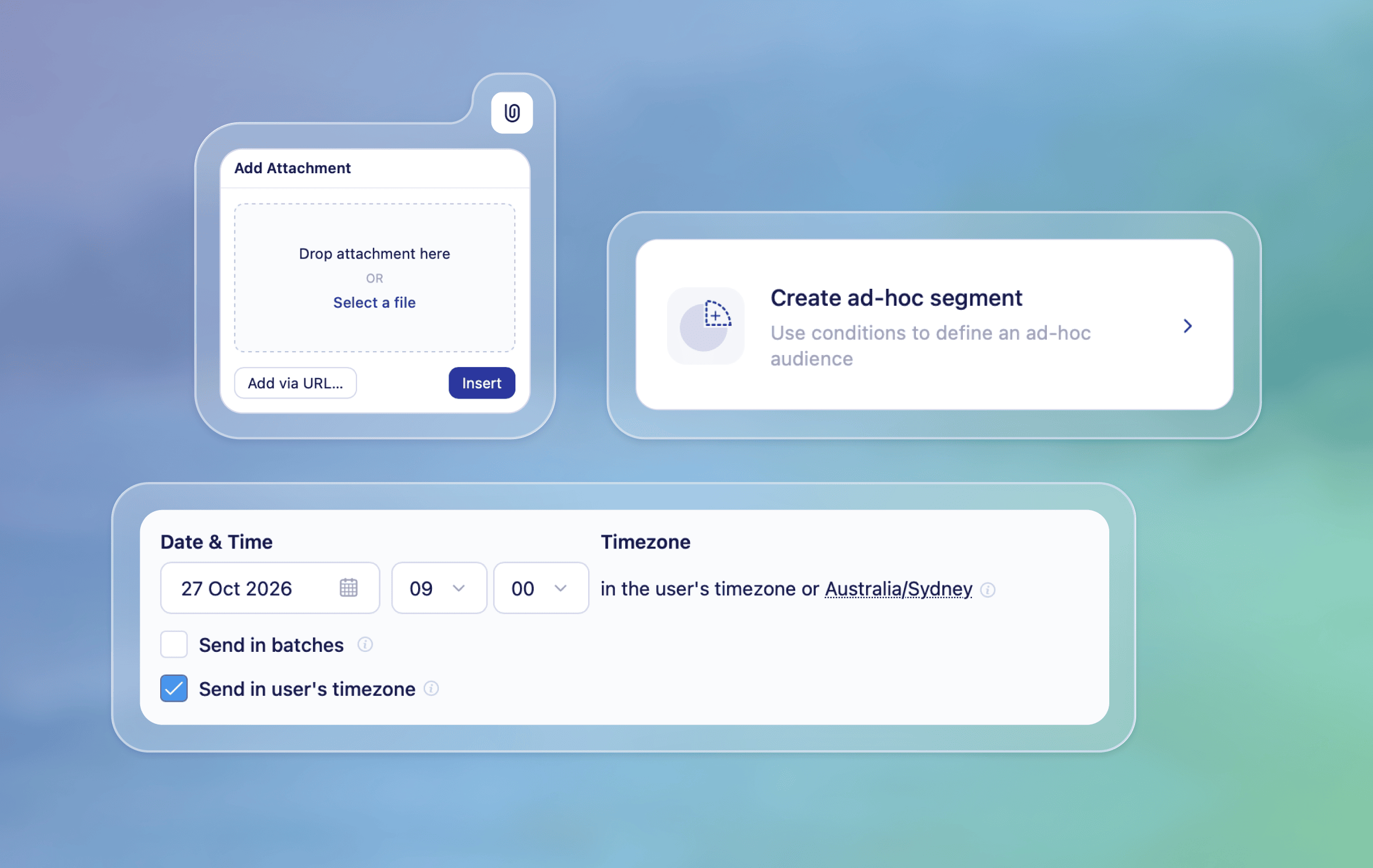
We're back with another round-up of what we shipped over the past few weeks. Subscription topics and the hosted preference center can now be managed by everyone in Vero 2.0, and broadcasts gain ad hoc segments, push, email attachments and sending in each recipient's timezone.

New

  • Ad hoc segments in broadcasts - In Vero 2.0 you can now define a broadcast's audience with conditions right inside the broadcast, without creating a segment first. Great for… This is a big improvement over Vero 1.0, newsletters which only allows sending to conditions of segments you'd already set up. Ah-hoc segments also support Refresh at send time so your audience matches your conditions at the moment the broadcast sends. Learn about ad-hoc segments

  • Subscription topics and preference center - All customers can now manage subscription topics and turn on the hosted preference center directly in the Vero 2.0 UI. From the new Subscription Management page, create topics, choose whether new profiles are subscribed by default, set the order topics appear in, and turn on the preference center so recipients can choose which messages they receive. Add {{url.manage_preferences}} to your emails to link to it, then select a topic on a broadcast or journey to send only to that topic's subscribers.

  • Send push broadcasts to ad hoc segments - In Vero 2.0 you can now send push broadcasts to an audience defined with an ad hoc segment, either immediately, scheduled for later, or on a recurring schedule.

  • Email attachments in Vero 2.0 - Add files to your broadcast and journey emails using a file URL and filename. Both support Liquid, so you can personalise attachments for each recipient. Attachments require a connected email provider and aren’t supported with Vero Managed delivery. Learn about attachments

  • Send in Timezone in Vero 2.0 - You can now schedule a Vero 2.0 broadcast to send at a chosen local time across your audience's timezones. Schedule it for 9am, for example, and sending starts at 9am in each recipient's timezone, rather than at one time for everyone. Vero uses timezone data from your connected audience first, then falls back to profile data and your project timezone. If you spread a send across batches, batch delays apply within each timezone, starting from its scheduled local time. Learn about sending in a users' timezone

Improved

  • Identify broadcast channels at a glance - The broadcast list now shows channel-specific icons for email, SMS, and push, making it easier to see which channel each broadcast uses without opening it.

  • Clearer launch checklist for A/B variants - It's now easier to see what's preventing your A/B campaign from launching. Launch checks identify which variant content needs attention, including its language where applicable. Expand an error to see content-specific details, so you can find and resolve the problem before launching.

  • Live campaign status updates - Campaign statuses in the campaigns list now update as they change, without needing to refresh the page.

  • Browse 100 audience profiles per page - Audience previews now show 100 profiles per page.

  • Sorting templates - You can now sort your template library by last updated (newest or oldest first) or by title (A–Z or Z–A). We've also tidied up the template page and show more templates by default.

  • Clearer properties in the data inspector - The data inspector now makes it clearer which user properties are available. When an audience hasn't been loaded, you'll see a note explaining that loading one will reveal more properties. For event-triggered messages and journeys, the inspector now shows the profile properties available for those messages, helping you see the data you can use while editing.

Fixes

  • Recurring broadcasts in local time - Fixed an issue where in some cases recurring broadcasts sent in local time could arrive an hour late in UTC+14, or stay on Sending after delivery had finished.

  • Default language labels - Fixed an issue where, content without a language set appeared as an added language instead of default content.

  • Tag updates - Fixed an issue where, in some cases, adding or removing tags could fail when other profile updates happened at the same time.

For any questions don't hesitate to reach out to support@getvero.com
Latest Updates

Here's a round-up of the new features, fixes and improvements we've shipped over the past few weeks. We're also still rolling out and improving Subscription Topics, the Preference Center, and Vero's MCP and API, and we'll share more once they're ready for everyone. In the meantime, contact support@getvero.com if you'd like early access.

New

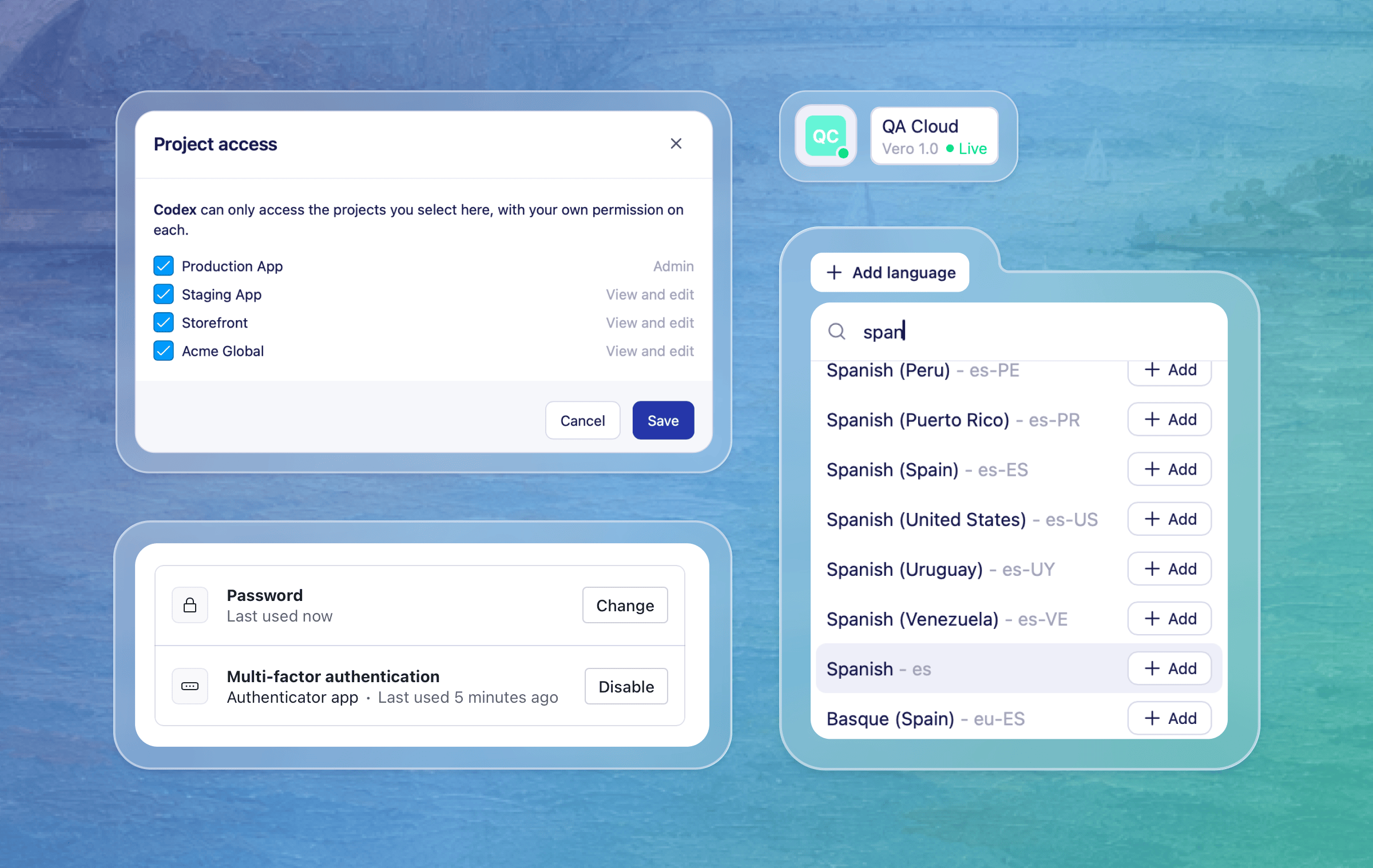
  • Multi-language content in Vero 2.0: You can now send a different language version of your campaign content to each profile in your broadcasts and journeys. This is one of the final steps in bringing all the features of Vero 1.0 to Vero 2.0. As before, Vero uses each profile's locale property to send the right version. The campaign Insights tab now also breaks down performance by language, so it's easier to compare and report on each version. As a reminder, you can also create language versions through Vero's MCP, and they show up right alongside the rest of your campaign content in Vero, so you can review and edit them in one place. Learn how to use languages in Vero 2.0

  • MCP management page: A new MCP page under your account settings lets you view and manage permissions for your connected AI agents like Claude and Gemini. You'll see every connected agent and which projects they have access to. You can limit an agent to specific projects, or remove it to revoke its access entirely. Learn about the Vero MCP

Improved

  • Project status at a glance: The compact sidebar now shows the current project's delivery status. Hover over the icon to see the project name, Vero version and delivery status without expanding the navigation.

  • Multi-factor authentication in Vero 2.0: We've updated the 2FA section in Settings → Security, which allows you to add an extra layer of protection to your account. If you sign in with Google or another identity provider, keep managing your sign-in security through that provider's account settings.

Fixes

  • Duplicate transactional option on broadcasts: In some cases, the transactional option appeared twice when setting up a broadcast. It now only shows once.

  • Recurring newsletter reliability: In some cases, recurring newsletters could time out before they finished sending. They now have more time to run, so scheduled sends complete reliably.

  • Clearer errors for recurring newsletter audiences: If a recurring newsletter's connected audience query fails, the campaign now shows a clearer error message. That gives you a chance to fix the query or data source before the next scheduled send.

  • Workflows after event retries: In rare cases, a retried event that had already been recorded could stop a workflow from being evaluated. Eligible profiles now continue through their workflows as expected.

  • Adding branches after random splits: In some cases, adding a True/False branch after a Random Split in a Journey showed an error, even though the branch sat outside the split. You can now add branches in this position.

  • Data feeds in broadcasts created via MCP or API: In some cases, broadcasts created with Vero's MCP tools or the API didn't render {{feed.…}} Liquid tags until you edited and re-saved the content in Vero. Feeds now render as soon as the broadcast is created. If the feed Liquid is invalid, Vero now returns a clear error message.

  • Gemini Enterprise connector: Gemini Enterprise can now discover and use Vero's MCP tools.

  • Improved recurring newsletter monitoring in Vero 2.0: We've improved how we monitor recurring newsletters in Vero 2.0. If a newsletter runs into trouble, we now catch it sooner and recover it automatically where we can, so your scheduled sends keep going reliably.

  • More reliable segment refreshes before sends: We've improved how segments are refreshed ahead of scheduled newsletters, so your audiences are ready in time and your newsletters go out when expected.

  • Liquid errors in message logs: If a message fails because of a Liquid syntax error, it now shows as a failure in the message logs with the error details. That makes it easier to find and fix the broken tag.

For any questions, don't hesitate to reach out to support@getvero.com.

NewImprovedFixedVero 1.0Vero 2.0

Latest Updates

It’s been a big few weeks — we’ve introduced new Journey building blocks, added more MCP tools and API endpoints and shipped a solid run of fixes and improvements. We’re also making good progress on some long awaited features, which we will be bringing you more info about soon.

As a reminder, the Campaigns API and MCP server are enabled on a per-account basis. Contact support@getvero.com if you'd like access.

New

  • Preference Center V2 (early access) – Group your messages into topics and give recipients a hosted page where they can choose what they hear about, instead of unsubscribing from everything. Topic preferences are respected across email, SMS and push, and can be set through the API or MCP. Available on request while we work towards the full rollout in Vero 2.0 — get in touch at support@getvero.com to request access and read the help docs to find out more.

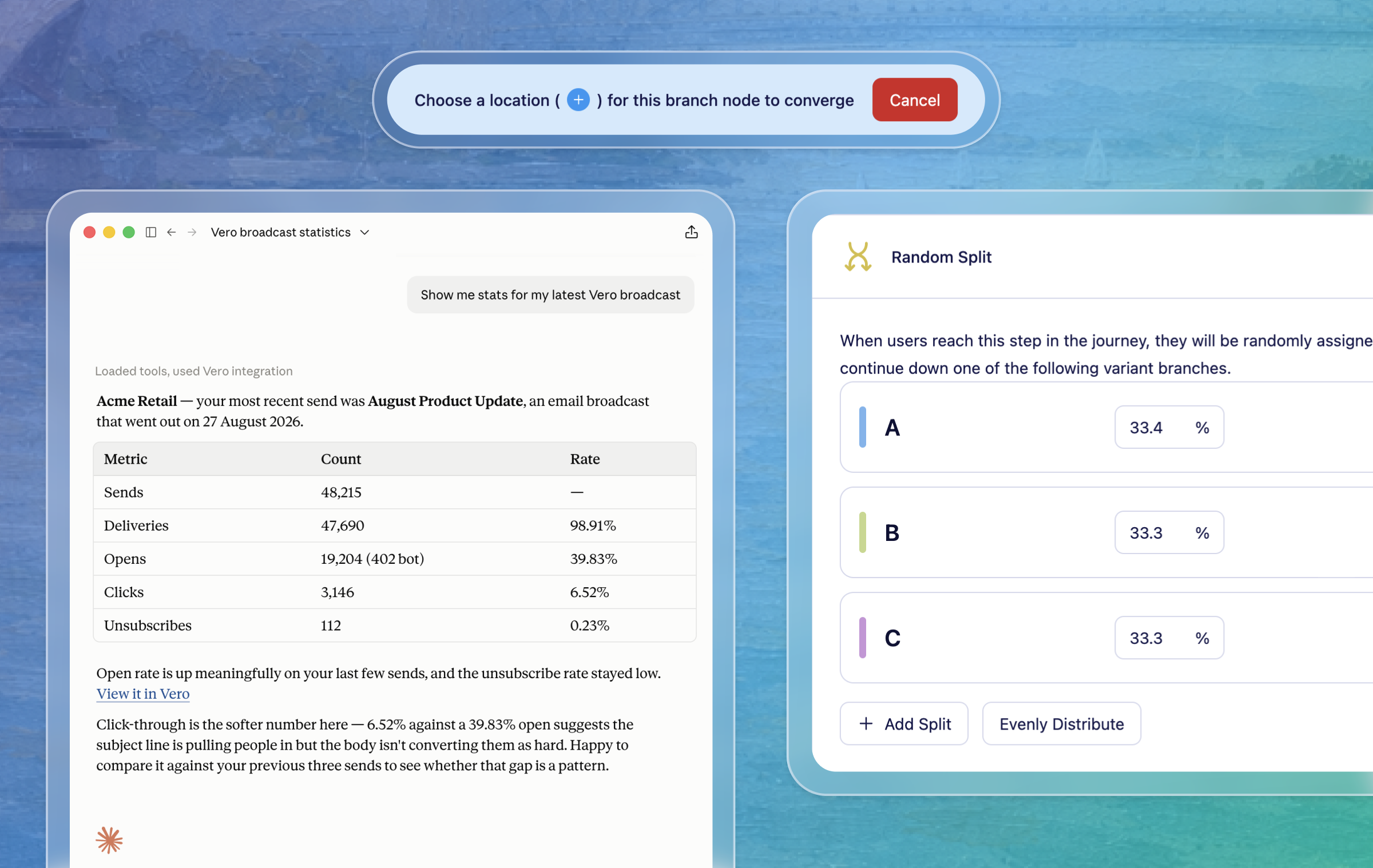
  • Random Split node in Journeys – A new Random Split node sends a set percentage of profiles down each path, so you can test variations of a journey against each other. Use it to compare message content, timing or channel choices within a single journey, rather than building and maintaining separate journeys to do the same thing.

  • Remove Exit nodes from Journeys – We've added a handy new way to remove exit nodes and rejoin them to different places in your journey. This makes it easy to undo adding an exit node, and adds another bit of flexibility when you're reshaping a journey that's already live.

  • A new sign-in experience – Vero has a new login page and a single, consistent sign-in, sign-up and logout flow across Vero 1.0 and Vero 2.0. Email and password and Google sign-in both work as before, and your existing login details carry across — there's nothing you need to do differently.

  • Connect AI clients to Vero with OAuth - MCP-enabled AI clients can now connect to Vero by signing in through your browser, rather than being configured with an API key. Authorise the client once and it picks up your existing Vero access.

  • Trigger Vero events from MCP - You can now trigger a Vero event for an existing customer profile directly from an MCP-enabled workflow, allowing events to start configured journeys or campaigns.

  • Journey and broadcast metrics in MCP - You can now retrieve performance metrics for journeys and broadcasts through MCP, including sends, deliveries, opens, clicks, unsubscribes, reporting dates, and per-message or per-run breakdowns.

  • Broadcast metrics in public API - Broadcast performance data is now available in the public API, including sends, deliveries, opens, clicks, unsubscribes, and per-run performance for recurring broadcasts.

  • Search across broadcasts, journeys, and messages - You can now search across broadcasts, journeys, and their messages in Vero's MCP tools. Results are grouped by type and include short snippets to help find campaign content faster.

  • Localised journey content through the API – New v2 endpoints let you write localised content for journey messages, so translations can be created and updated from your own systems instead of being maintained by hand in the journey builder. This brings journey messages in line with how localised content is already handled elsewhere in Vero.

Improved

  • Faster segments and reporting – Segment refreshes, timeline charts and usage counts all run noticeably quicker. The difference is most obvious on larger accounts, where segment counts and reporting views previously took the longest to load.

  • Unverified channel warnings – Vero now flags an unverified sending channel while you're setting up a campaign, rather than at send time. You can sort out verification before scheduling, instead of finding out about it when the campaign is due to go out.

  • Improved MCP validation for broadcast content - AI clients now get clearer guidance on supported content formats for email, SMS, and push messages, with earlier and more helpful validation errors for invalid requests.

  • Journey message lists are paginated in MCP – Large journeys now return in pages instead of one oversized response.

  • Removing From and To email addresses – Before you delete an email address, Vero now shows which campaigns use it in a From or To field, so you can see exactly what will be affected and how.

Fixes

  • Faster email event reporting – Email activity reporting is now more reliable. We fixed an issue that could delay delivery, open, and click events from appearing in campaign reporting. New email events will now show up more promptly across your campaign statistics.

  • Correct verification status for Vero Managed channels – Vero Managed email channels would sometimes show an incorrect “unverified” warning when setting up a campaign with a Vero managed email provider.

  • Webhook payloads restored – _comm_occ_id and message _variation_id are back in webhook payloads after being dropped in a recent release. If you use these fields to match webhook events to a specific send or variation, no changes are needed on your side.

  • Archiving campaigns with broken conditions – In some cases a campaign with corrupt conditions couldn't be archived, leaving it sitting in your campaign list with no way to tidy it away. These campaigns can now be archived as normal.

  • Audience update dialog – In some cases the confirm button in the audience update dialog did nothing, so the change wasn't applied. Confirming now saves the update as expected.

  • Import progress – Progress didn't update for imports sourced from a segment, which made a running import look like it had stalled. Progress now updates throughout the import.

For any questions don't hesitate to reach out to support@getvero.com
Earlier updates